Visit NBCNews.com for breaking news, world news, and news about the economy
Trailer for the movie:
Showing posts with label U.S. Military. Show all posts
Showing posts with label U.S. Military. Show all posts
Tuesday, December 03, 2013
Lone Survivor and NBC's Interview
I must say that it is been quite a long time since the last time I was anxious for a movie to come out. First and foremost, I have a tremendous amount of respect and admiration for the U.S. Armed Forces and what they do around the globe. They put down their lives for the safety and security of American overseas and at the same time, they are fighting a very unethical enemy in a very ethical format. These American soldiers deserve all the respect for what they are doing for America and the world. At the same time, I am glad to see that Hollywood has finally decided to abandon “make-belief” anti-war movies were mostly either had fictional stories or one simple incident that the producer turned it into war-movie were they defame all the soldiers. We went through that phase during Bush’s presidency and that simply had something to do with Hollywood’s hatred for Bush. I believe there were number of movies that bashed these poor soldiers and not even one single of these movies did well at the box office. The reason for that was simple: Americans see right through the B.S and the so-called Whistle-blowing-wana-be nature of these movies. Well, here is an interview from the cast and the issue that came up with Tom Cruise.


Friday, January 06, 2012
Difference Between Savagery and Civilization

A heavily-armed counter-piracy team from the Navy destroyer USS Kidd met little resistance when they boarded the dhow where they found 15 armed pirates and the 13 Iranians who were being held hostage. The pirates were taken into custody. The Iranians were set free in their dhow.MSNBC.COM
This is the difference between savagery and civilization. Although Iranian Government has been threatening and destabilizing the region for internal gains, the American gesture has been more than kindly. Iranian Regime take hostages to show-off their non-existence power and suppress the opposition, Americans release the Iranian Hostages by utilizing and threatening the lives of their best soldiers. All politics aside, it was a great gesture from U.S. I cannot wait for all the ungrateful responses from Iranian Government and their propaganda mouth-pieces’ abroad.

To these people, Iran is always the victim. However, they are right, Iranians are the victims, but the perpetrators are the Iranian murderous Regime and their supporters.
Thursday, December 29, 2011
Iran is Itching to be Attacked

Iran is playing with the fire. I wrote it in the previous post about how Iran is desperate to restore its image. Now, they are going a step further. I think they are actually trying to stir up some sort of conflict in order to buy the support for the regime just like the way they did the same thing during Eight Years with Iraq that was over two years into the wear. However, they chose to continue the war in order to use that as an excuse to murder and wipe out the opposition groups and establish full control over the nation. It worked beautifully. Their excuse: We got Attacked! It was the Iranians and Khomeini’s terrorists who tried to mingle in Iraqi’s internal politics by trying to support a Shia Uprising against Saddam. They called it “exporting our Islamic Revolution” and it is well-documented in Montazeri’s Memoires. Saddam took advantage of the opportunity and attacked Iran.
Iran has been threatening the region by closing down the Strait of Hormuz and now they are tracking and filming American Aircraft Carriers. If that is not enough, they publicize such an act which is nothing but act of desperation or stupidity. A well capable military would never ever need to televise its intelligence reports or capabilities on the state televisions. The situation is getting worse by the hour and Iran is escalading the situation by their stupid comments or acts in order to provoke the Americans. (MSNBC.com) However, there are more to these acts and I think it is absolutely brilliant.
It seems to me that the Iranian Regime is basically trying to pull the same stunt. I think they are trying to somehow agitate Americans or the Israelis to attack them. They are full-well aware of the fact that US will not conduct full-scale war and take over the country given Afghanistan and Iraq situation. Therefore, any military strike would be a simple tactical military strike in order to destroy Iran’s military installations and Nuclear Facilities. Ultimately, the regime will stay in power and they could use the same excuse that they got attacked. It is a total win-win situation for them.

Given this day and age and the technology, I hardly believe they could simply buy Iranian support if Iran gets attacked. With the progress of social media and its usage in Iran, I don’t think Iranians would be fooled into supporting this deadly regime. I believe they are going to use this attack as an excuse to launch full scale war against the opposition and completely wipe them out. I mean mass graves and mass executions would be underway for anybody who dare to question a simple thing about this regime.
In conclusion, Iran is itching for an attack. That’s why they are doing stupid things like this to agitate the world powers. They know that the globe is thirsty for oil and no matter what happens, their product is in high demands. Russia and China will be more than glad to get that oil. However, they need to stay in power and I believe a military strike against Iran will ensure its survival if it is a tactical strike. The questions is whether survival of this regime is worth allowing this regime to become nuclear, and the answer is a clear no, because if they do grab the bomb, then there is no stopping this regime. Therefore, I am sorry Iranians, I believe you guys are doomed!
Tuesday, July 05, 2011
Unknown Heroes Behind the Mission that Located Osama Bin Laden

This is an amazing story about a man who was behind the mission who captured the arch terrorist of our decade or possibly this century. Heroes like these never receive public acknowledgment of their success nor will they ever be publicly thanked by the main-stream Media. It has to do with these agents safety and security. However, some of it has to do with the fact that our society has lost touch with who are the true heroes of our society. They are more concerned about consumerist and pop-culture heroes or some dumb singers, actors, and/or activist doing something for publicity stunt and they hold them up as to be the icon of our society. However, heroes like these don’t need public recognition of their good work. I believe they get the true satisfaction when they can see the title “mission accomplish” and that would be more than enough for them. From bottom of my heart, I salute heroes like “John” and I thank them for their hard work. Here is the story from MSNBC.com:
WASHINGTON — After Navy SEALs killed Osama Bin Laden, the White House released a photo of President Barack Obama and his Cabinet inside the Situation Room, watching the daring raid unfold.
Hidden from view, standing just outside the frame of that now-famous photograph was a career CIA analyst. In the hunt for the world's most-wanted terrorist, there may have been no one more important. His job for nearly a decade was finding the al-Qaida leader. The analyst was the first to put in writing last summer that the CIA might have a legitimate lead on finding Bin Laden. He oversaw the collection of clues that led the agency to a fortified compound in Abbottabad, Pakistan. His was among the most confident voices telling Obama that Bin Laden was probably behind those walls.
The CIA will not permit him to speak with reporters. But interviews with former and current U.S. intelligence officials reveal a story of quiet persistence and continuity that led to the greatest counterterrorism success in the history of the CIA.
Nearly all the officials insisted on anonymity because they were not authorized to speak to reporters or because they did not want their names linked to the Bin Laden operation.
The Associated Press has agreed to the CIA's request not to publish his full name and withhold certain biographical details so that he would not become a target for retribution.
Call him John, his middle name. John was among the hundreds of people who poured into the CIA's Counterterrorism Center after the Sept. 11 attacks, bringing fresh eyes and energy to the fight.
Disparate strands
He had been a standout in the agency's Russian and Balkan departments. When Vladimir Putin was coming to power in Russia, for instance, John pulled together details overlooked by others and wrote what some colleagues considered the definitive profile of Putin. He challenged some of the agency's conventional wisdom about Putin's KGB background and painted a much fuller portrait of the man who would come to dominate Russian politics.
That ability to spot the importance of seemingly insignificant details, to weave disparate strands of information into a meaningful story, gave him a particular knack for hunting terrorists. "He could always give you the broader implications of all these details we were amassing," said John McLaughlin, who as CIA deputy director was briefed regularly by John in the mornings after the 2001 attacks.
From 2003, when he joined the Counterterrorism Center, through 2005, John was one of the driving forces behind the most successful string of counterterrorism captures in the fight against terrorism: Abu Zubaydah, Abd al-Nashiri, Khalid Sheik Mohammed, Ramzi Bin Alshib, Hambali and Faraj al-Libi. But there was no greater prize than finding Bin Laden. Bin Laden had slipped away from U.S. forces in the Afghan mountains of Tora Bora in 2001, and the CIA believed he had taken shelter in the lawless tribal areas of Pakistan.
In 2006, the agency mounted Operation Cannonball, an effort to establish bases in the tribal regions and find Bin Laden. Even with all its money and resources, the CIA could not locate its prime target.
By then, the agency was on its third director since Sept. 11, 2001. John had outlasted many of his direct supervisors who retired or went on to other jobs. The CIA doesn't like to keep its people in one spot for too long. They become jaded. They start missing things. John didn't want to leave. He'd always been persistent. In college, he walked on to a Division I basketball team and hustled his way into a rotation full of scholarship players.
The CIA offered to promote him and move him somewhere else. John wanted to keep the Bin Laden file. Champagne was uncorked at the CIA's headquarters after it was confirmed that Navy SEALs had killed Osama Bin Laden.
He examined and re-examined every aspect of Bin Laden's life. How did he live while hiding in Sudan? With whom did he surround himself while living in Kandahar, Afghanistan? What would a Bin Laden hideout look like today?
'We'll get there'
The CIA had a list of potential leads, associates and family members who might have access to Bin Laden. "Just keep working that list bit by bit," one senior intelligence official recalls John telling his team. "He's there somewhere. We'll get there." John rose through the ranks of the counterterrorism center, but because of his nearly unrivaled experience, he always had influence beyond his title. One former boss confessed that he didn't know exactly what John's position was. "I knew he was the guy in the room I always listened to," the official said. While he was shepherding the hunt for Bin Laden, John also was pushing to expand the Predator program, the agency's use of unmanned airplanes to launch missiles at terrorists.
The CIA largely confined those strikes to targets along Pakistan's border with Afghanistan. But in late 2007 and early 2008, John said the CIA needed to carry out those attacks deeper inside Pakistan. It was a risky move. Pakistan was an important but shaky ally. John's analysts saw an increase in the number of Westerners training in Pakistani terrorist camps. John worried that those men would soon start showing up on U.S. soil. "We've got to act," John said, a former senior intelligence official recalls. "There's no explaining inaction." John took the analysis to then CIA Director Michael Hayden, who agreed and took the recommendation to President George W. Bush.
In the last months of the Bush administration, the CIA began striking deeper inside Pakistan. Obama immediately adopted the same strategy and stepped up the pace. Recent attacks have killed al-Qaida's No. 3 official, Mustafa Abu al-Yazid, and Pakistani Taliban leader Baitullah Mehsud. All the while, John's team was working the list of Bin Laden leads. In 2007, a female colleague whom the AP has also agreed not to identify decided to zero in on a man known as Abu Ahmed al-Kuwaiti, a nom de guerre.
Other terrorists had identified al-Kuwaiti as an important courier for al-Qaida's upper echelon, and she believed that finding him might help lead to Bin Laden. "They had their teeth clenched on this and they weren't going to let go," McLaughlin said of John and his team. "This was an obsession." It took three years, but in August 2010, al-Kuwaiti turned up on a National Security Agency wiretap. The female analyst, who had studied journalism at a Big Ten university, tapped out a memo for John, "Closing in on Bin Laden Courier," saying her team believed al-Kuwaiti was somewhere on the outskirts of Islamabad.
Bigger picture
As the CIA homed in on al-Kuwaiti, John's team continually updated the memo with fresh information. Everyone knew that anything with Bin Laden's name on it would shoot right to the director's desk and invite scrutiny, so the early drafts played down hopes that the courier would lead to Bin Laden. But John saw the bigger picture. The hunt for al-Kuwaiti was effectively the hunt for Bin Laden, and he was not afraid to say so. The revised memo was finished in September 2010. John, by then deputy chief of the Pakistan-Afghanistan Department, emailed it to those who needed to know. The title was "Anatomy of a Lead."
As expected, the memo immediately became a hot topic inside CIA headquarters and Director Leon Panetta wanted to know more. John never overpromised, colleagues recall, but he was unafraid to say there was a good chance this might be the break the agency was looking for.
The CIA tracked al-Kuwaiti to a walled compound in Abbottabad. If Bin Laden was hiding there, in a busy suburb not far from Pakistan's military academy, it challenged much of what the agency had assumed about his hideout.
But John said it wasn't that far-fetched. Drawing on what he knew about Bin Laden's earlier hideouts, he said it made sense that Bin Laden had surrounded himself only with his couriers and family and did not use phones or the Internet. The CIA knew that top al-Qaida operatives had lived in urban areas before. A cautious Panetta took the information to Obama, but there was much more work to be done. The government tried everything to figure out who was in that compound.
In a small house nearby, the CIA put people who would fit in and not draw any attention. They watched and waited but turned up nothing definitive. Satellites captured images of a tall man walking the grounds of the compound, but never got a look at his face.
Again and again, John and his team asked themselves who else might be living in that compound. They came up with five or six alternatives; Bin Laden was always the best explanation.
This went on for months. By about February, John told his bosses, including Panetta, that the CIA could keep trying, but the information was unlikely to get any better. He told Panetta this might be their best chance to find Bin Laden and it would not last forever. Panetta made that same point to the president.
Panetta held regular meetings on the hunt, often concluding with an around-the-table poll: How sure are you that this is Bin Laden? John was always bullish, rating his confidence as high as 80 percent. Others weren't so sure, especially those who had been in the room for operations that went bad. Not two years earlier, the CIA thought it had an informant who could lead him to Bin Laden's deputy. That man blew himself up at a base in Khost, Afghanistan, killing seven CIA employees and injuring six others.
That didn't come up in the meetings with Panetta, a senior intelligence official said. But everyone knew the risk the CIA was taking if it told the president that Bin Laden was in Abbottabad and was wrong. "We all knew that if he wasn't there and this was a disaster, certainly there would be consequences," the official recalled.
Reassuring confidence
John was among several CIA officials who repeatedly briefed Obama and others at the White House. Current and former officials involved in the discussions said John had a coolness and a reassuring confidence.
By April, the president had decided to send the Navy SEALs to assault the compound. Though the plan was in motion, John went back to his team, a senior intelligence official said. "Right up to the last hour," he told them, "if we get any piece of information that suggests it's not him, somebody has to raise their hand before we risk American lives."
Nobody did. Inside the Situation Room, the analyst who was barely known outside the close-knit intelligence world took his place alongside the nation's top security officials, the household names and well-known faces of Washington.
An agonizing 40 minutes after Navy SEALs stormed the compound, the report came back: Bin Laden was dead. John and his team had guessed correctly, taking an intellectual risk based on incomplete information. It was a gamble that ended a decade of disappointment. Later, Champagne was uncorked back at the CIA, where those in the Counterterrorism Center who had targeted Bin Laden for so long celebrated. John's team reveled in the moment.
Two days after Bin Laden's death, John accompanied Panetta to Capitol Hill. The Senate Intelligence Committee wanted a full briefing on the successful mission. At one point in the private session, Panetta turned to the man whose counterterrorism resume spanned four CIA directors.
He began to speak, about the operation and about the years of intelligence it was based on. And as he spoke about the mission that had become his career, the calm, collected analyst paused, and he choked up.
Click here for the link to the story on MSNBC.com
Friday, May 27, 2011
Cartoons that Say it All
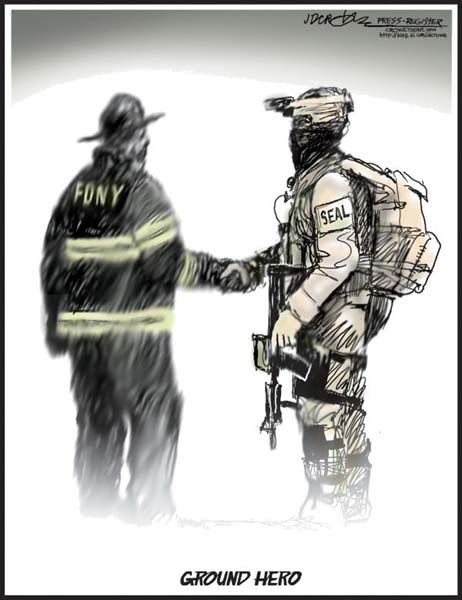
Memorial Day Weekend is upon us. Although I will probably be working through the weekend, I would like to take a moment to honor the brave men and women in uniform who have taken upon themselves to defend this country. I saw this cartoon and I thought to myself that this is one of the best cartoons I have ever seen. So I decided to put it up on my blog.

I also saw these two cartoons that made me laugh. I believe the artists in both of these cartoons nailed it.


At the end, I wish everybody safe Memorial Day Weekend and don’t forget to honor our men and women in uniform.
I also saw these two cartoons that made me laugh. I believe the artists in both of these cartoons nailed it.


At the end, I wish everybody safe Memorial Day Weekend and don’t forget to honor our men and women in uniform.
Friday, October 02, 2009
Afghanistan is Not Iraq

Ok, we’re under President Obama rule now. He is our President and there is nothing you could do about it. However, one thing that pisses me off is what the hell happened to the “Anti-War” people. I thought they were against the war and against violence. Why did they vanish? The reason I am asking this question is because Obama is talking about increasing troops for Afghanistan and he is investing more money in that country.
Personally, I think it is a horrible mistake. I am not saying we’re defeated and we should cut and run. The reason I am saying this is because Afghanistan is not Iraq. Sorry to say this but THERE IS NO HOPE FOR AFGHANISTA. Afghanistan is not Iraq. Iraq has future and there is hope for Iraq. But Afghanistan does not have anything.
The difference between the situations in Iraq and Afghanistan is that Iraq has natural resources. On top of that, Iraq has an educated population too that could take over the government. The natural resources could pay for rebuilding Iraq and the educated population could assist the democracy to work. Iraq at the same time has been thirsty for democracy. Yes, there are crazies in Iraq too. There are sectarian differences, however thank to Al-Qaeda and their terrorism that devastated this country, people have decided to set aside their differences at least for now. At the same time, the only reason Iraq fell apart in the beginning was that there were not troops in the region and the country was not secured. It was the lack of management of the war by President Bush that forced Iraq into chaos. At the same time, it was also the Media and their hatred of Bush that added fuel into the fire in Iraq. The terrorists quickly realized that if they could destabilize Iraq, they have enough allies in the U.S with same hatred of Bush that they could force U.S to pull back. They were successful to some extent. With every soldier that died in Iraq, the media actively assisted those terrorist by highly publicizing it. They were all screaming: “Vietnam, Vietnam” or loonies such Cindy Sean who grossly took advantage of her son’s death to push her own wacky ideologies on the Americans. Directors such as Michael Moore and other morons were just adding more fuel to the fire. Thank G-d, with exception of Michael Moore movie, none of the movies made a dime and they were a complete loss. However, the only benefit was terrorists were gaining more power and moral support. Of course, Democrats being out of power at the time were also benefiting from it. Let’s just say, Iraq fell apart because of many reasons that could have been prevented. I don’t want to go too much into detail of what happened.
However, Afghanistan is not Iraq. Afghanistan is not Iraq though. Afghanistan does not have any natural resources. Meaning, there is no money to rebuild it. Who is going to pay to rebuild this country in this economic mess that we’re in today? Afghanistan does not have any infrastructure. There are no roads, no electricity, no clean water, and many other goods that a country a needs. At the same time, the worst part is that not that many educated people live there. The country is so backward that it would take hundreds of years to bring it even remotely up to date in terms of infrastructure, education, and political process. This country has been devastated by tribal war for many many years and there is almost no change in sight. The country is still heavily religious and the signs of Taliban practices and rules and can been seen everywhere. The practicing religion has an extreme sect of Islam which is Wahabisim. The same type practiced in Saudi Arabia. There are other type of Islam there too, however it seems like Wahabists are incredibly powerful in that country. I have said before and I say now, Wahabisim will never ever work with democracy and it is the most violent type of Islam that needs to be eradicated. I don’t care if it is someone’s religion; Wahabsim is almost like Nazism and should not be tolerated in any sense or form. Strategically speaking, Afghanistan is located where there are a lot of mountains around. This will provide natural shields for all types of insurgent activities. Iraq was flat; tanks could easily relocate from one place to another. Troops could easily be transferred from one location to another. However in Afghanistan, it is not so easily achieved. The weather, geographical location, and existence of no road make military activity a hell. Investing more troops in Afghanistan will not work that well. I really hope it does, but I think Obama is making a huge mistake in this case.
In conclusion, the only apparent thing in here is the hypercriticism of politics and of course of the Left. They were screaming “peace peace peace”! I still remember the signs that say: “fighting for peace is like fucking for virginity”. My question is what happened to the virgin? What happened to peace? Did they abandon it? What happened to media criticizing this president and his decision? When Bush (worst Commander in Chief in U.S history) with recommendation and pleas of generals in Pentagon especially General David Petraeus wanted to increase the troops, they were criticizing him left and right, but now they are completely silent on this matter? At the end, I think Obama and Left are creating another Vietnam and our troops are going to pay a hefty price for it. I hope not, but that’s the direction we’re headed.
Tuesday, January 29, 2008
A Funny Way to Storm a Building (Be not the safest)
I don't know why but somehow this is really really funny to me.
Subscribe to:
Posts (Atom)